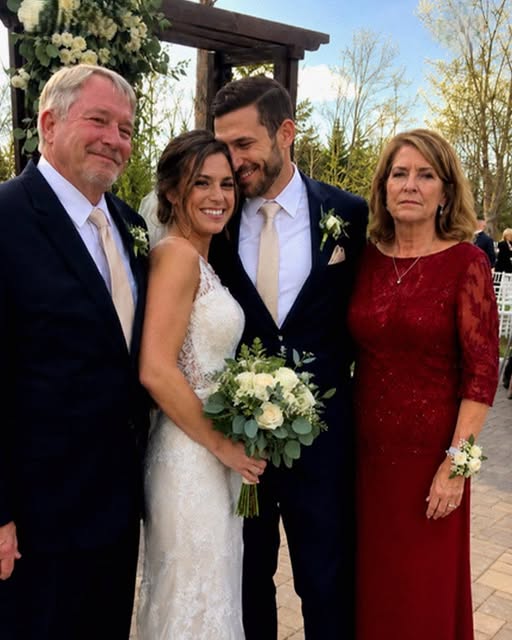
The wedding reception was meant to be the happiest evening of our lives. The ballroom sparkled beneath crystal chandeliers, white roses decorated every table, and laughter filled the room as friends and family celebrated our future together. Everything felt perfect until my mother-in-law stood up, took the microphone without warning, and turned what should have been a joyful celebration into a moment I thought would haunt me forever.
She slowly looked around the room before fixing her eyes on me.
“I think it’s time someone said what everyone has been thinking,” she announced.
The music faded, conversations stopped, and more than two hundred guests turned toward her.
With a smile that barely concealed her resentment, she accused me of marrying her son for his money. She mocked my upbringing, laughed about my father’s repair shop, and claimed I had carefully planned my relationship with Russell simply to gain access to his family’s wealth.
The room fell into stunned silence.
I sat frozen beside my new husband, unable to believe what I was hearing. Every cruel word felt heavier than the last. I could feel dozens of eyes shifting between Deborah and me, waiting to see how I would respond. Embarrassment, heartbreak, and disbelief crashed over me all at once.
My husband immediately stood and told his mother to stop.
She ignored him.
Instead, she continued listing reasons why she believed I didn’t belong in their family, insisting that people from “our side of town” had very different intentions than people from hers.
I wanted nothing more than to disappear.
Then I felt my father’s hand gently squeeze mine.
Jimmy had always been a quiet man. He spent decades repairing engines in a small garage outside town, believing that actions mattered more than words. Throughout my life, he rarely raised his voice, but when he did speak, people listened because they knew every word came from honesty.
Slowly, he stood up.
He didn’t look angry.
He didn’t shout.
He simply adjusted his jacket and calmly walked toward the center of the ballroom.
I reached for his sleeve.
“Dad… please.”
He smiled reassuringly.
“It’s alright,” he whispered.
“I’ve got this.”
The room became completely silent as he approached Deborah.
With remarkable composure, he asked a simple question.
“How well do you actually know my daughter?”
Deborah folded her arms.
“I know enough.”
My father nodded thoughtfully.
“No,” he replied.
“I don’t believe you do.”
From inside his jacket, he removed a worn leather folder that I had seen him carry for years but had never questioned. It looked ordinary, its edges softened from age and constant use.
He carefully opened it.
“I’ve never carried this because I expected to use it,” he said.
“I carried it because every parent wants to remember the moments that define their child.”
The first document he held up wasn’t a financial record.
It was a certificate recognizing hundreds of volunteer hours at the local nursing home.
“When Emily was sixteen,” he explained, “she spent nearly every Saturday visiting residents whose families rarely came to see them.”
He placed it on the table.
Then he revealed another folder.
“This one contains letters from teachers.”
One by one, he read brief passages describing how I stayed after school tutoring younger students without ever asking for recognition.
Another envelope contained thank-you notes from families whose children I had mentored through community programs.
Then he held up medical paperwork.
Several guests leaned forward.
“A few years ago,” he said, “our elderly neighbor, Mrs. Evelyn, was diagnosed with a serious illness.”
He paused.
“Emily quietly used nearly every dollar she had saved for a new car to help pay expenses that insurance wouldn’t cover.”
I felt tears filling my eyes.
I had never told anyone outside my family about that.
My father smiled gently.
“She asked me never to mention it because she believed kindness loses something when it’s done for attention.”
The room remained silent.
He continued opening the folder.
There were receipts showing donations to local shelters.
Certificates recognizing community service.
Letters from organizations thanking anonymous volunteers.
Every document told the same story.
Not of wealth.
Not of ambition.
But of compassion.
Finally, my father closed the folder.
He turned toward Deborah.
“You called my daughter a gold digger.”
His voice remained calm.
“But everything she’s ever worked for has been about giving—not taking.”
He looked around the ballroom.
“I raised her in a small house behind a repair shop.”
“We didn’t have much.”
“But I taught her that a person’s value isn’t measured by the size of a bank account.”
“It’s measured by the size of their character.”
He then turned to Russell.
“My daughter never asked what your family owned.”
“She only asked whether you were kind.”
Russell walked over and wrapped his arm around me.
“I fell in love with Emily long before I ever told her anything about my family’s finances,” he said.
“In fact, when we first met, she insisted on paying for half of every date.”
Several guests smiled.
Others quietly nodded.
Russell continued.
“When I offered to help with her bills after she lost her apartment lease, she refused.”
“She told me she’d rather work extra hours than depend on someone else.”
He looked directly at his mother.
“The woman you’re describing doesn’t exist.”
“The woman standing beside me is the strongest, most generous person I’ve ever known.”
Deborah stood speechless.
For perhaps the first time that evening, she realized the room was no longer listening to her accusations.
They were listening to the truth.
One by one, guests began applauding.
The applause spread across the ballroom until nearly everyone was standing.
It wasn’t applause meant to embarrass Deborah.
It was applause for integrity.
For kindness.
For a father who knew his daughter so well that he had quietly preserved the story of her character long before anyone ever questioned it.
Later that evening, after the music had resumed and the celebration continued, I asked my father why he had kept all those papers.
He smiled the same gentle smile I had known since childhood.
“Because people can make up stories about who you are,” he said.
“But the life you’ve lived always tells the real one.”
That night taught me something I’ll never forget.
Reputation can be attacked in a matter of minutes.
Character is built over a lifetime.
And when the truth is supported by years of quiet acts of kindness, it has a way of speaking louder than even the cruelest accusations ever could.