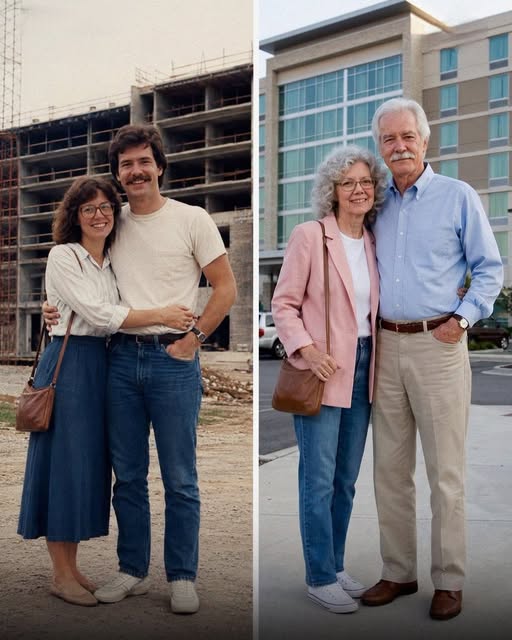
Three days after burying my husband of thirty-seven years, I found myself sitting in a lawyer’s office hearing words I never imagined I would hear. According to his will, I wasn’t receiving the house we had shared, any portion of his fortune, or even a personal letter explaining his decision. Everything had been carefully distributed to business associates, distant relatives, and charitable organizations. My name was nowhere to be found. As the attorney calmly finished reading the document, I felt as though my entire marriage had been erased with a few signatures.
The days that followed were filled with confusion and heartbreak. I wandered through the large home Graham and I had built together, packing photographs, books, and memories into cardboard boxes while trying to understand how the man who had promised to stand beside me forever could leave me with nothing. Friends offered sympathy, but no one could answer the question that consumed every waking moment: why? Even my own attorney confirmed there was little hope of successfully challenging such a carefully prepared will. Legally, everything appeared to be in order.
Looking back, our story had begun long before Graham became a successful businessman. We met in college with little more than ambition and determination. I remembered the nights we shared inexpensive meals while he sketched business ideas on napkins, dreaming of opening his first hotel. We celebrated every milestone together, survived financial setbacks, and spent decades building a life neither of us could have imagined in those early years. That history made the contents of the will feel even more impossible to accept.
A week after the funeral, just as I was preparing to leave the house for good, a courier arrived carrying a package with my name written in Graham’s familiar handwriting. The delivery had been scheduled months earlier with precise instructions that it was not to arrive until that specific day. Inside were old photographs, faded receipts from our first apartment, handwritten notes, and small keepsakes from the earliest years of our marriage. Beneath everything rested a short letter.
“If you’re reading this,” Graham had written, “please trust me one last time. Keep looking. Everything you truly need is hidden at the bottom.”
His words made no sense.
As I carefully sorted through the contents, the doorbell rang again.
Standing outside was Mr. Sterling, the attorney who had handled Graham’s estate.
Gone was the calm professionalism he had displayed during the reading of the will.
His expression was tense.
“I need that package,” he said firmly.
“It’s part of the estate.”
Something about his urgency immediately raised my suspicions.
Just hours earlier, he had insisted I was entitled to nothing.
Now he seemed desperate to recover a box he claimed belonged to the estate.
I politely refused.
His tone quickly changed.
“You don’t understand what you’re dealing with.”
Without another word, I closed the door.
Moments later, loud knocking echoed through the house.
I carried the package into Graham’s study, locked the door behind me, and continued searching.
Beneath a false layer inside the box was another handwritten note.
“Check my oak desk.”
Heart pounding, I walked across the room and examined the desk I had dusted thousands of times over the years without noticing anything unusual.
Following Graham’s instructions, I pressed against the underside of one drawer until a hidden compartment quietly released.
Inside were neatly organized folders, financial records, bank statements, and handwritten notes.
The deeper I looked, the clearer the picture became.
Graham hadn’t hidden money.
He had hidden evidence.
Page after page documented what appeared to be years of financial fraud involving shell companies, forged invoices, and unauthorized transfers connected to someone I never would have suspected.
Mr. Sterling.
Detailed notes in Graham’s handwriting explained how he had gradually uncovered millions of dollars missing from company accounts. Every discovery was carefully dated and supported by documents.
Then I found the final letter.
“My love,” it began.
“If you’ve found this, then my plan worked.”
He explained that shortly before his death, he realized the business was facing investigations that would inevitably expose years of financial crimes committed without his knowledge. Although he intended to cooperate with authorities, his illness progressed faster than expected.
There wasn’t enough time.
So he made an impossible decision.
“If I leave you part of the estate,” he wrote, “you become connected to everything that follows.”
“The investigations.”
“The lawsuits.”
“The endless questions.”
“But if you’re left completely outside the estate, you’re protected.”
For the first time since his funeral, I understood.
He hadn’t abandoned me.
He had sacrificed my inheritance to shield me from the legal storm he knew was coming.
Tears blurred the pages as I continued reading.
“There are things more valuable than money,” he wrote.
“Your freedom.”
“Your peace.”
“Your future.”
Outside, the pounding on the study door grew louder.
Mr. Sterling’s voice no longer sounded confident.
It sounded desperate.
“Open the door!”
“We can work something out!”
His panic confirmed everything Graham had written.
Instead of responding, I picked up my phone and called the police.
I calmly explained that I believed I had discovered financial records connected to a large-scale fraud.
Within minutes, officers arrived.
When I finally unlocked the study door, Mr. Sterling pushed inside expecting to intimidate me into surrendering the documents.
Instead, he found uniformed investigators waiting behind me.
His expression changed instantly.
The confidence disappeared.
He tried insisting there had been a misunderstanding, then claimed the records had been fabricated.
But the evidence spoke for itself.
Investigators carefully collected every document from the hidden compartment while additional officers escorted Sterling from the house.
Over the following months, forensic accountants confirmed years of embezzlement involving millions of dollars. The records Graham preserved became central to the investigation, helping authorities unravel an elaborate network of fraudulent transactions that had quietly drained the company for years.
As the legal proceedings unfolded, it became clear that Graham had anticipated almost everything. By excluding me from the estate, he had ensured I wasn’t financially or legally entangled in the investigations that followed. Although losing the inheritance had initially felt like the greatest betrayal imaginable, it ultimately became the very decision that protected me from years of legal uncertainty.
When the investigation concluded, the remaining legitimate assets of the business were reorganized through the courts. Because the fraud had been uncovered and Graham’s intentions were fully documented, I eventually received what mattered most—not simply financial security, but the truth about the man I had loved for nearly four decades.
People often assume love is measured by grand gestures or expensive gifts.
Sometimes its greatest expression is a decision that looks cruel on the surface but is made entirely out of protection.
For a brief time, I believed my husband had left me with nothing.
In reality, he had left me the greatest gift he possibly could.
He left me with the truth, my innocence, and the chance to begin again.