I’m Michael Ross, and I was a ghost in my own house for two arduous years. When a doctor spoke those three heartbreaking words, “I’m so sorry,” my world had practically ended in a sterile hospital corridor. In a moment, my wife Lauren and our six-year-old son Caleb were taken by an intoxicated motorist. After that, our home’s stillness started to seem like a physical burden. Caleb’s bright paintings were still pinned to the refrigerator, mocking the silence of a once-vibrant existence, and his sneakers were still by the entrance. The bedroom we used to share seemed like a tomb, so I slept on the couch and lived on takeout and TV static. I was forty years old, yet it seemed like a century had gone by since I had a purpose in life.
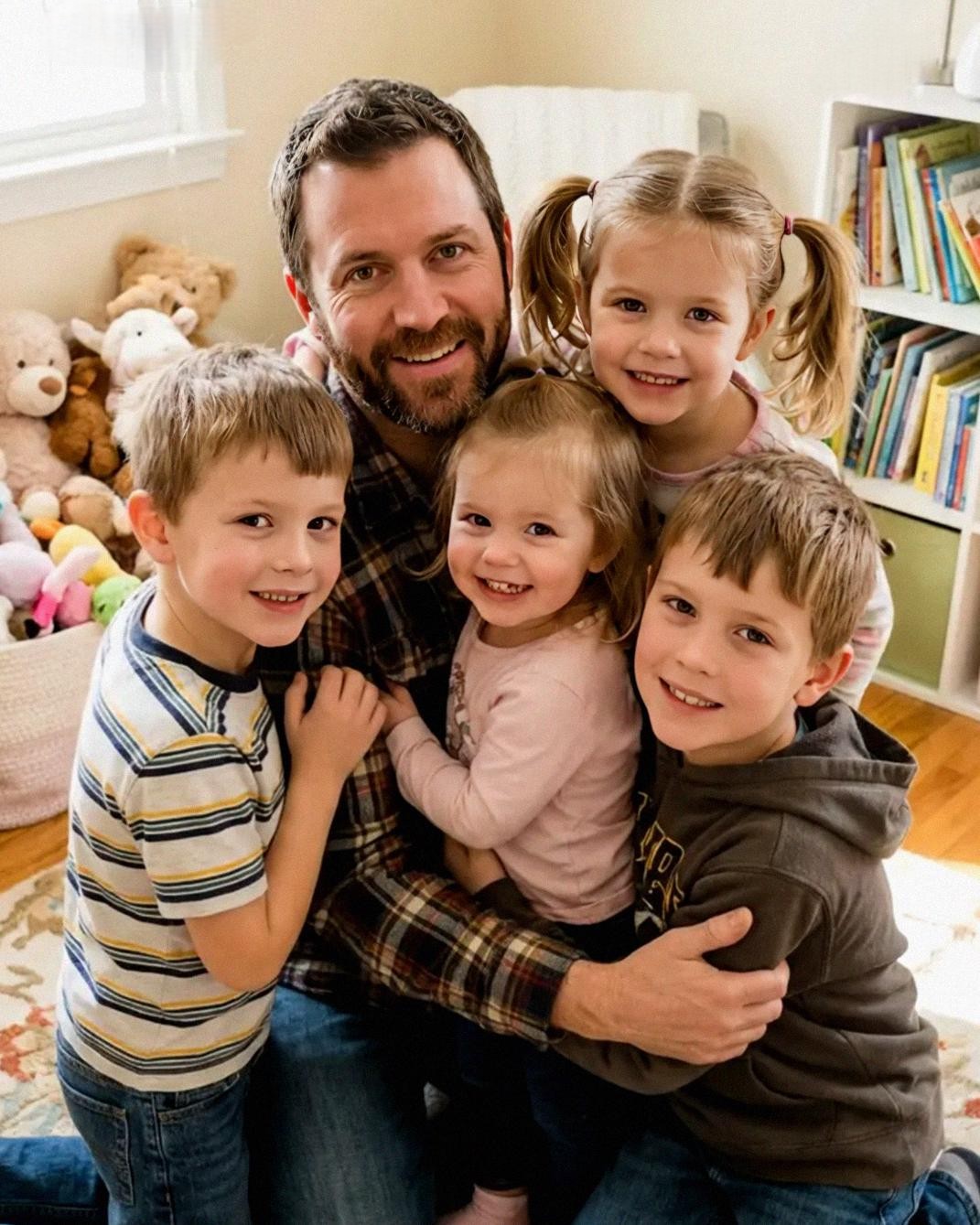
On a random Tuesday at two in the morning, that all changed. In my grief-induced daze, I was browsing Facebook when I came across a post that broke my heart. A photo of four siblings—Owen, Tessa, Cole, and Ruby—was included in an appeal from a nearby child welfare organization. They appeared less like youngsters and more like refugees from a private conflict as they snuggled together on a seat. “Likely be separated” was a gut-punching caption. The system was getting ready to place the four of them in separate foster homes since their ages ranged from three to nine. They were about to lose each other after losing their parents in an automobile accident.
I was unable to fall asleep. Owen’s arm was always encircling his sisters in a protective manner. The idea of these kids being split up because they were “too much” for the typical family made me feel something I hadn’t felt in years: justifiable indignation. I knew what it was like to leave a hospital by myself. I contacted the agency early the following morning, before the sun had risen. I expressed my desire to take them to Karen, the social worker. All four of them—not just the two youngest.
It was a difficult procedure. I had to demonstrate to state officials and therapists that I wasn’t only attempting to make up for Lauren and Caleb’s absence from my life. I told them the truth: I was still here, and my house was far too quiet, but I was still mourning, and I always would be. Tension was high when I finally saw the children in a visitation room filled by fluorescent lights. Tessa, who was seven years old, was particularly wary of me and kept a close eye out for any indication that I would be rejected. Even at nine years old, Owen bore the burden of a parent. “I’m not interested in just one of you,” I informed them plainly. I want every single one of you.
The changeover was a maelstrom of chaos. Instead of echoing, my house began to vibrate with the noises of dreams, stomping feet, and spilled juice. I would spend hours sitting on Ruby’s floor, telling to her that she was secure, while she sobbed for her mother in the dark of night. During temper outbursts, Cole would yell that I wasn’t his biological father, and I would coolly concur while maintaining control over his actions. The “me” and “them” gradually gave way to “us.” I burnt grilled cheese sandwiches, walked on Legos, and discovered the complex social dynamics of primary school. One night, Owen accidentally called me “Dad,” and even though he froze in shame, I felt a warmth in my chest that reassured me that everything would be well.
We had fallen into a chaotic, lovely pattern of homework and soccer matches around a year after the adoption was approved when a stranger showed up at my house. Susan, a lady with a bulky leather briefcase and a nice suit, identified herself as the children’s biological parents’ lawyer. I felt sick to my stomach because I thought there could be a legal loophole that might take them away. But when we were setting aside bowls of cereal at the kitchen table, she shared a bombshell that completely altered the situation.
Susan’s birth parents had come to create a comprehensive will before to their unfortunate tragedy. They were planners, but they were also young and in good health. They had set up a trust for their kids in that agreement, which comprised a modest but significant life insurance payment and a tiny residence. However, the will’s most important component was a desperate written appeal rather than the money. They had made it clear that their kids would never be apart. They had asked that their kids remain in one house under one guardian in the event of the unimaginable.
Susan’s eyes were filled with tears as she gazed at me. She said, “You did exactly what they prayed for.” “And you did it without even realizing there was a dime.” She gave me the keys to their original family residence, a beige cottage in the trust that had been vacant across town.
I loaded the kids into the car that weekend. I kept our destination a secret from them. The automobile fell silent as we approached the cottage with the maple tree in the front yard. Then, like a wave, they were struck with recognition. Tessa said, “I know this house.” Running through the rooms, they came upon the swing set in the backyard where they had spent their early years and the pencil markings on the wall where their heights had been measured. Their first parents’ affection for them was captured in this time capsule.
With wide eyes, Owen approached me in the kitchen. “Dad, why are we here?” I got down on his level and told him that his original parents had loved them so much that they had made plans for their future, even after they had passed away. I informed them that their parents’ greatest wish was for them to live together forever and that the house belonged to them. When Owen inquired whether we had to go back, I assured him that we would maintain our existing house and that it would be a part of their future, something they could decide what to do with as they grew older.
After putting all four of them to bed that evening, I sat on the couch and became aware of how profoundly symmetrical our lives were. They had lost their family, and I had lost mine, but we had created something completely new in the rubble of those two tragedies. I didn’t save those children because I was unaware of a house or a trust fund. Because I understood what it was like to be alone, I saved them. The bequest was really a last, silent “thank you” from two parents who could now relax knowing their kids were together, where they were supposed to be. Although I am not their birth father and I will never be able to take the place of the guy they lost, I am the one who came to their aid when everything else sought to destroy them. No system can ever sever the link that unites us as a family—not by blood, but by a decision made at two in the morning.