For single mothers, it’s like walking a tightrope over a canyon of expenses and exhaustion. I measure my existence by the amount of time between paychecks and the exact amount of gas needed to get to Friday. I’ve become an expert at stretching a dollar until it groans, and I’ve mastered the art of saying we can’t afford it in a way that hides the underlying shame of my financial status. My nine-year-old daughter, Mia, is everything to me. She routinely bursts through the door with stories about playground politics and lunchroom drama before her backpack ever touches the floor.
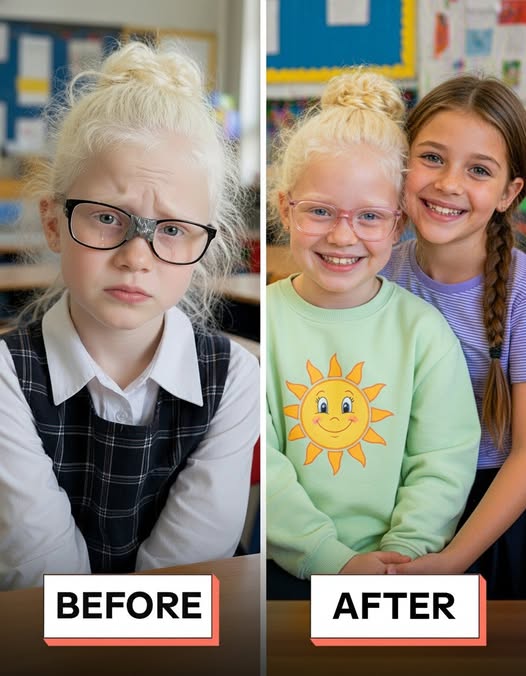
The silence on Tuesday felt so heavy because of this. Silently, Mia came home. She didn’t ask for a food or ramble on about recess. With an expression too worn out for a little child, she simply sat at the kitchen table and stared off into the distance. When I finally sat down across from her and asked what was wrong, her lower lip trembled. She told me about her friend Chloe. During a volleyball match, Chloe’s glasses were struck and shattered. The lenses remained intact, but the frames—which were held together by thick, unsightly pieces of duct tape—broke in half.
Mia’s voice broke when she mentioned that Chloe was being bullied. The other kids were nasty, mocking the tape and asking if she could see through the rubble on her face. Chloe spent her recess sobbing and hiding in the bathroom since she believed her parents couldn’t afford to replace them at this time. I felt a tingle of recognition in my chest. I was aware of the specific kind of stillness you experience as a child when you realize your parents are struggling and decide not to add to their burden.
Can we help her? Mia asked, her eyes bright with anticipation. I wanted to say yes. I want to be the mother who can put an end to a friend’s suffering with a simple card swipe. However, my bank account was a series of alerts rather than a balance. The energy bill was getting closer, and our larder was becoming smaller. “I’m so sorry, baby, but I can’t pay for someone else’s glasses right now,” I had to tell her honestly. Mia didn’t argue. She merely nodded solemnly and went back to her room.
The next afternoon, when I returned from work, the house was strangely altered. There was no sign of Mia’s massive Lego container, a colorful treasure trove filled with birthday gifts, Christmas kits, and hard-won trophies spanning four years. When Mia saw me, she was happy rather than sad. She said, “Mom, I fixed it.” She handed me a tattered receipt from the local optical shop.
I was stunned. She had enlisted the help of our neighbor, Mrs. Tanya, whose kid adored Legos. The entire collection had cost him $112. After walking to the store, Mia found Chloe’s file with the help of a helpful clerk and paid for a new set of frames and a store credit for future adjustments. When I asked her why she would give up her favorite thing in the world, she looked at me as if the reason were obvious: Mom, Chloe was crying in the bathroom.
I thought that act of pure, selfless kindness was where the narrative ended. I was wrong. The following morning, when I was working at my first job, my phone rang. It was Mia’s instructor, Ms. Kelly. Her voice sounded tense. She added that I was asked to come to the school immediately since Chloe’s parents were in the office and were quite upset. I felt my blood freeze. I assumed they were angered by the donation or that a minor’s transaction had created a legal issue.
As I barged into the principal’s office, the atmosphere was dense enough to choke. Chloe’s mother was sobbing, and her father seemed to be about to lose it. Mia stood by the desk, her head bent as if she had done something wrong. I immediately stepped in between my daughter and the angry parent, demanding to know what was happening.
Chloe’s father stood up, his mouth clinched. “Your daughter paid for my child’s glasses,” was his stern response. I told him that Mia’s only reason for lending a hand was because she thought they couldn’t afford the replacement. The room fell silent abruptly. Then the reality came to light, and it wasn’t what I had expected. Chloe’s parents did not live in poverty. In actuality, they were extremely affluent.
They explained that Chloe had lost or broken several pairs of glasses over the course of the previous year due to what they deemed to be carelessness. They had told her that in order to teach her a lesson in responsibility, she would have to wear the taped-up frames until the weekend. They reasoned that she would be more circumspect in the future after a few days of mild humiliation. They had no idea that their lesson in responsibility had led to their daughter’s nightmare of bullying and social rejection.
Finally, sobbing, Chloe said that she had told Mia they couldn’t afford them because she was too ashamed to admit her parents were punishing her. It looked like the parents had been struck. The father’s anger was replaced by a dreadful wave of guilt. It was the first time he saw Mia when he turned to face her. He asked if she had really sold all of her Legos. She nodded, and he asked if I had told her to do it.
“No,” Mia replied. I saw that she needed help.
At that moment, the stress subsided. Chloe’s mother leaned in front of Mia and asked whether she realized how much she had given up for a friend. Mia blinked and said they were just Legos, but Chloe’s smile seemed more significant. The adults in the room were at a loss for words. A nine-year-old child had shown more grace, sensitivity, and knowledge than all the “lessons” the parents had tried to teach.
A few days later, we were invited to Chloe’s parents’ home. Although it was a beautiful house—the kind I usually felt uneasy in—they welcomed us with genuine humility. While the girls were playing upstairs, they sat me down and handed me a folder. It contained the paperwork for a savings account they had opened in Mia’s name for college. They told me that they wanted to honor a young kid who understood that giving shouldn’t wait for perfect conditions. They were investing in their daughter’s future because she had given her all to make her happy.
When I put Mia to bed that night, I asked if she had missed her Legos. She smiled into her pillow and said, “A little, but Chloe smiles more now.” I sat in the dark for a while after she went to sleep, gazing at the empty space where her toy bin once stood. I spent a lot of my life worrying about the things I couldn’t give my kid, including holidays, luxury like brand-name clothes, and a double salary. But as I stared at that emptiness, I realized that I had given her something much more valuable. I had raised someone who could identify other people’s misery and act to lessen it. The kind of light that filled the space was anything but empty, and no amount of money could ever buy it.