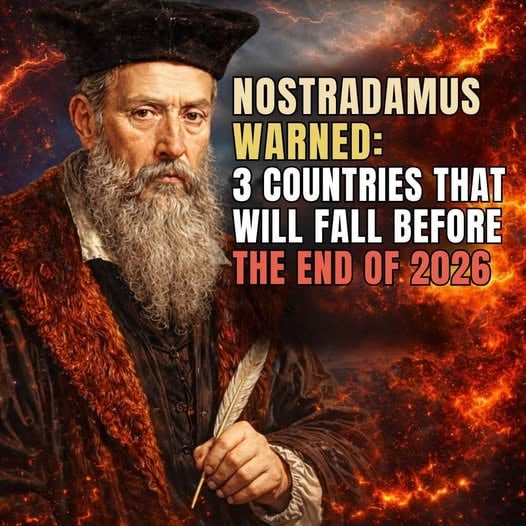
Some claim that the warning indicators are already clearly visible. The grim imagery found in the writings of Nostradamus, the enigmatic 16th-century physician whose cryptic forecasts have captivated humanity for centuries, seems to be echoed by wars, political division, economic instability, falling trust in institutions, and rising global tension. His quatrains, which were once written off by many as esoteric medieval poetry, now seem eerily pertinent to those looking for purpose in an increasingly insecure world. Three powerful forces were weaker. Relationships were strained. Pressure causes outdated systems to fracture. It no longer sounds like far-off symbolism to believers. It sounds like a caution.
Nostradamus wrote amid a time of political terror, religious strife, war, and plague. Living in France in the sixteenth century, he had a profound understanding of how civilizations may become unstable when uncertainty outgrew stability. In order to avoid accusations of heresy or persecution, he purposefully filled his writings with riddles, symbols, mixed languages, and ambiguous imagery. This may have been due to his belief that history itself evolves through patterns rather than straight lines. He depicted emotional and symbolic landscapes that future generations could understand through the prism of their own problems rather than making explicit prophecies.
His prophecies have endured for centuries because of this ambiguity.
His allusions to monsters and symbols are frequently interpreted by modern readers in light of current geopolitics. The United States, plagued by polarization, debt, cultural difference, and dwindling institutional trust, is the “weakened eagle.” Some associate the “old lion” with the United Kingdom, a former imperial state grappling with identity, economic hardship, and shifting global importance. Naturally, the “great bear” conjures up images of Russia, a country beset by internal strife, geopolitical isolation, and conflict. Regardless of whether those interpretations are true or not, they have an emotional impact because they capture actual fears that exist in contemporary society.
However, Nostradamus’s writings seldom depict abrupt apocalyptic endings, which is what makes them very captivating. Rather, they frequently allude to times of transition—painful times when established structures of authority start to crumble and something strange gradually emerges beneath the surface. Empires deteriorate. Alliances break up. Once-permanent systems lose the trust of the populace. However, history itself keeps advancing.
Compared to many dramatic online interpretations, that viewpoint is more in line with reality. Dominant powers have always emerged, grown, declined, and changed throughout history. Before it broke up due to internal and external pressure, the Roman Empire seemed unstoppable. Before crumbling quickly in a matter of decades, colonial empires changed the world for centuries. Once-eternal political and economic structures have frequently shown themselves to be ephemeral. People inherently believe that the buildings around them will endure forever, until all of a sudden they don’t.
The fact that many people really feel that modern civilization is unstable is what brings Nostradamus back into the spotlight now, rather than any evidence of supernatural foresight. The emotional environment that makes prophecy psychologically appealing once more is created by a number of factors, including economic uncertainty, rapid technological change, AI disruption, climate worry, conflicts, disinformation, political extremism, and societal disintegration. When the future seems terrible, people look for patterns. Even though their meanings are still unclear, ancient prophecies provide an odd feeling of order amid chaos.
The writings of Nostradamus also serve as mirrors. His symbols are frequently used by readers to directly express modern anxieties. His verses depict military collapse during conflicts. They discover illness and plague during pandemics. They learn about revolution and collapsing governments during political turmoil. Because of the language’s flexibility, each generation is able to reinterpret the predictions in accordance with the problem that seems most dangerous at the moment.
The writings do not always become meaningless as a result. Their ability to depict recurrent human cycles—fear, ambition, collapse, transformation, and renewal—is, in a sense, what gives them their power. History frequently passes through times when societies are worn out by dysfunctional structures. Naturally, the current period feels like one of those turning times due to growing mistrust and quickening global change.
However, the narrative seldom concludes with complete destruction, even in the most sinister readings of Nostradamus. The “fall” of great powers typically signifies change rather than extinction. Hegemony fades. There are new political and cultural frameworks. Painful identity shifts are followed by a return to stability. Humanity endures, albeit frequently altered in the process.
This distinction is important because when individuals start viewing uncertainty as evidence of an impending collapse, anxiety itself can become deadly. Numerous instances of prophecy-driven fear have occurred throughout history, typically during times of societal unrest. However, societies are also remarkably flexible. After wars, depressions, natural calamities, and political upheaval, people constantly rebuild. Not only do crises influence the future, but people’s collective reactions to them also do.
Maybe that’s the subtle lesson that lies underlying the allure of Nostradamus. Emotional paralysis—the conviction that collapse is inevitable and that people have no agency left—is the true threat, not just anarchy on the outside. In actuality, resilience frequently increases most during times of instability. When outdated systems seem unreliable, community, critical thinking, emotional equilibrium, flexibility, and collaboration become increasingly important.
Therefore, it is indisputable that humanity is going through a moment of profound change, regardless of whether Nostradamus actually predicted current geopolitical tension or if people are just projecting their current anxieties onto old poetry. Conventional wisdom regarding identity, technology, power, and stability is quickly being questioned.
And maybe that’s why his poetry still lingers in people’s minds today. Not because they provide accurate forecasts, but rather because they encapsulate a timeless aspect of civilization itself: the unnerving insight that every era eventually reaches a point at which the world that people once believed to be eternal starts to subtly change into something strange.