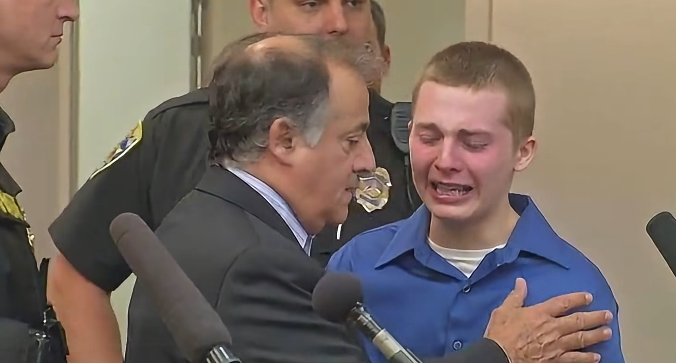
The courtroom fell completely silent as the young defendant stood before the judge awaiting his fate. Although his appearance reflected his youth, the charges against him carried consequences of extraordinary weight. When the final sentence was announced, a wave of disbelief spread throughout the room. The judge imposed a prison term totaling 452 years—a number so immense that it seemed almost impossible to comprehend. In an instant, a future that had barely begun appeared permanently erased, leaving observers struggling with a difficult question: how should society respond when someone so young commits acts with devastating consequences?
As the sentencing concluded, emotions that had been restrained throughout the lengthy trial erupted into the open. Families of the victims, who had endured months of painful testimony and relived unimaginable losses, viewed the sentence as a necessary acknowledgment of the harm that had been done. For them, the punishment represented accountability on the largest possible scale. They spoke of loved ones whose lives had been cut short, dreams that would never be realized, and wounds that would never fully heal. In their eyes, the severity of the sentence reflected the gravity of the suffering left behind.
The defense, however, offered a very different perspective. They focused on the defendant’s age and the reality that adolescence is a period of growth, development, and change. According to their argument, the young man’s life had been shaped by difficult circumstances, poor influences, and failures that extended beyond his own decisions. They questioned whether eliminating every possibility of eventual freedom served the interests of justice or simply represented society giving up on someone before they had the opportunity to mature and transform.
Outside the courthouse, the case quickly became a source of national discussion. Public opinion divided sharply as people debated the broader implications of the verdict. Supporters of the sentence argued that some crimes are so serious that age alone cannot outweigh the need for permanent accountability. They maintained that protecting society and honoring the victims required consequences that reflected the enormity of the offenses.
Others viewed the sentence through a different lens. Critics questioned whether condemning a teenager to spend the remainder of his life behind bars, with no realistic possibility of release, aligned with the principles of rehabilitation often associated with juvenile justice. They argued that young people possess a unique capacity for change and that a sentence extending centuries beyond a human lifespan raises profound ethical concerns.
The discussion soon expanded beyond the specific facts of the case. It evolved into a larger conversation about punishment, redemption, and the purpose of the justice system itself. Should justice focus primarily on retribution for harm committed, or should it also preserve opportunities for growth and rehabilitation? Is there a point at which punishment becomes symbolic rather than practical? These questions became central to the debate surrounding the verdict.
For many observers, the case highlighted the difficult balance courts must strike when dealing with serious crimes committed by young offenders. On one side lies the responsibility to recognize the suffering of victims and ensure public safety. On the other lies the belief that youth carries with it the potential for transformation, even after terrible mistakes.
As weeks passed, the case continued generating discussion among legal experts, policymakers, and members of the public. Some viewed the sentence as a necessary statement about accountability. Others saw it as evidence of deeper challenges within a system struggling to reconcile punishment with the possibility of redemption.
Regardless of where opinions fall, the verdict has become a significant point of reference in ongoing conversations about juvenile justice. It forces society to confront difficult questions about responsibility, forgiveness, and the limits of rehabilitation. It asks whether a person should be defined forever by the worst actions of their life or whether change should remain possible regardless of past wrongdoing.
The young defendant now faces a future that will unfold entirely behind prison walls. The victims’ families continue carrying their grief. Legal advocates continue debating the implications of the sentence. And the public remains divided over what true justice requires in circumstances where both the harm committed and the punishment imposed seem almost beyond measure.
Ultimately, the case leaves behind more than a legal ruling. It leaves a lasting debate about the values that shape modern justice and the choices societies make when deciding how to balance accountability, safety, mercy, and hope.