If you spend enough time online, you have probably encountered those deceptively simple riddles that seem easy at first glance but somehow manage to confuse thousands of people within seconds. They spread rapidly across social media because they force readers to slow down, rethink what they just read, and realize how easily the human brain can be tricked by language. One of the most popular examples in recent years involved the famous “Penny’s children” puzzle, which used a predictable sequence of months to mislead people into giving the wrong answer almost immediately.
Now, a new variation featuring a baker named Mr. Smith is creating the exact same kind of confusion online.
At first, the riddle appears completely straightforward:
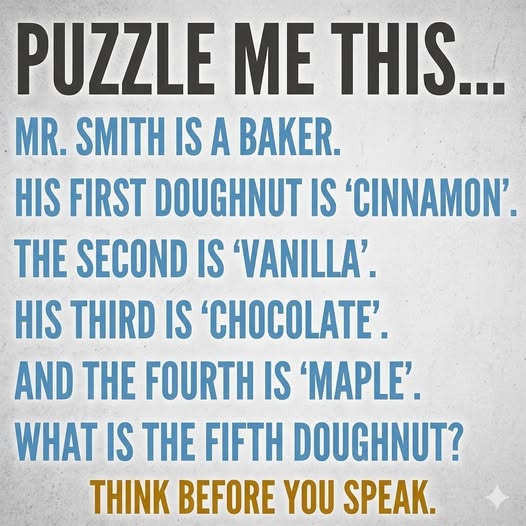
Mr. Smith is a baker.
His first doughnut is “Cinnamon.”
The second is “Vanilla.”
The third is “Chocolate.”
And the fourth is “Maple.”
What is the fifth doughnut?
Most people instantly begin searching for another flavor to continue the sequence. Some guess strawberry. Others say blueberry, glazed, caramel, or powdered sugar. The brain naturally assumes the puzzle must involve identifying a hidden pattern between the listed doughnut flavors.
But that assumption is exactly what causes people to fail the riddle.
The correct answer is actually: “What.”
In other words, the fifth doughnut is literally named “What.”
The trick works because the riddle manipulates the way people instinctively process language and punctuation. When readers reach the final line — “What is the fifth doughnut” — their brain automatically interprets the word “What” as a question rather than considering that it may itself be the answer. The mind becomes so focused on continuing the flavor sequence that it ignores the possibility of a literal interpretation.
This is what makes riddles like this so effective and satisfying once the answer is revealed. The puzzle does not rely on advanced math, logic, or hidden codes. Instead, it depends entirely on how quickly the human brain jumps toward assumptions before carefully analyzing the wording itself.
Psychologists often describe this type of mistake as a result of pattern recognition and cognitive priming. Human beings are naturally wired to search for patterns because pattern recognition helps the brain process information faster and more efficiently. In everyday life, this ability is extremely useful. It helps people predict outcomes, understand language, and make quick decisions. But in riddles like this, those same mental shortcuts become weaknesses that can easily be manipulated.
The moment the riddle lists several doughnut flavors in a row — Cinnamon, Vanilla, Chocolate, Maple — the brain immediately categorizes the information as a sequence puzzle. Readers begin searching for connections between flavors, letters, or hidden ordering systems. Once the brain commits to that expectation, it starts skimming over grammatical details instead of reading carefully.
That is why the final line becomes so deceptive.
Readers automatically assume “What” functions as a question word because their mind is already locked into “solve the pattern” mode. They stop paying attention to the literal structure of the sentence itself. By the time they realize the trick, their brain has usually already committed to an entirely different answer.
The warning at the end — “Think before you speak” — adds another clever psychological layer. It encourages people to rush toward an answer while pretending to encourage caution, which makes the reveal feel even more satisfying when the trick becomes obvious afterward.
Riddles like this remain popular because they create a unique combination of frustration, amusement, and surprise. People enjoy the sudden moment when confusion transforms into clarity. Even when someone gets the answer wrong, the simplicity of the trick often makes them laugh at themselves afterward. That reaction is part of what keeps these puzzles spreading across social media platforms so quickly.
More than anything, puzzles like the “Mr. Smith doughnut riddle” reveal something fascinating about human thinking. They show that intelligence is not only about knowledge or logic — it is also about attention, patience, and the willingness to question assumptions. Sometimes the brain works so quickly trying to solve a problem that it completely overlooks the obvious answer sitting directly in front of it the entire time.