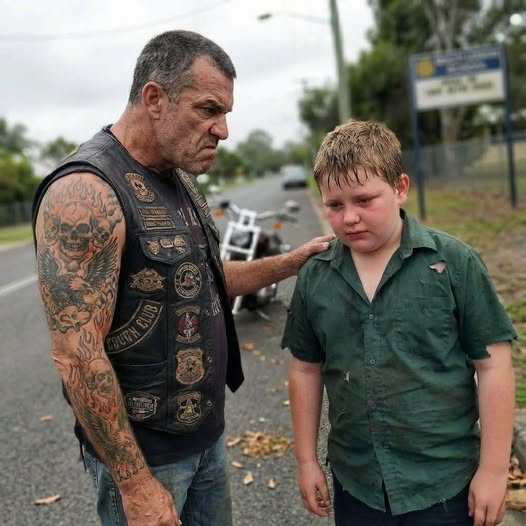
The quiet country road stretched for miles with hardly another vehicle in sight when I noticed a young boy walking alone along the shoulder. His head was lowered, his clothes were torn, and his slow, exhausted steps suggested he had been walking for quite some time. Even from a distance, it was obvious that something wasn’t right. As I eased my motorcycle to the side of the road, a feeling of concern settled in. A child shouldn’t have been alone in that condition, miles from town, looking so defeated.
When I approached him, I gently asked if everything was okay.
Without looking up, he quietly answered, “I’m fine.”
It was the kind of response many adults recognize immediately—not because it sounded convincing, but because it sounded practiced. His voice carried the weight of someone trying to hide far more than he was willing to say. His eyes told a completely different story. They reflected fear, exhaustion, and sadness far beyond what any child should have to carry alone.
I stayed with him for a few minutes, speaking calmly and without pressure. Gradually, his guarded silence began to fade. Piece by piece, he explained that school had become a place he dreaded. Day after day, he had been dealing with relentless bullying that left him feeling isolated and powerless. What hurt the most wasn’t simply the teasing or the physical intimidation—it was the feeling that there was no safe place to escape it.
As he continued talking, one detail stood out more than anything else.
He wasn’t worried about himself.
He was worried about his mother.
With remarkable maturity, he admitted that he hadn’t told her what was happening because she already had enough to worry about. He didn’t want to add another burden to her life. Listening to him, it became painfully clear that he had convinced himself protecting his mother was more important than asking for help. No child should ever feel responsible for carrying that kind of emotional weight.
Many children who experience bullying remain silent for similar reasons. Some fear the bullying will become worse if they speak up. Others worry they won’t be believed, or they don’t want to upset the people who care about them. What often appears to be strength is actually loneliness. Behind quiet smiles and simple answers like “I’m okay” can be a child silently struggling every single day.
A short time later, his mother arrived after being contacted. The relief on her face when she saw her son was immediate, but it was quickly followed by heartbreak as he finally shared everything he had been keeping inside. The conversation wasn’t easy. There were tears, difficult questions, and emotions that had been building for weeks or even months. Yet it also marked the beginning of something important. For the first time, he no longer had to carry his pain by himself.
Speaking about a problem doesn’t erase it overnight, but it allows others to help shoulder the burden. That simple conversation opened the door to support that had been impossible while everything remained hidden.
In the days that followed, members of our local riding community offered encouragement and practical assistance. Nobody was interested in becoming the center of attention or creating unnecessary confrontation. Instead, the focus remained where it belonged—on making sure the boy knew he wasn’t alone and helping his family connect with the appropriate support systems.
Support can take many forms. Sometimes it’s helping parents communicate with school administrators. Sometimes it’s encouraging a child to keep speaking honestly about what they’re experiencing. Sometimes it’s simply showing up consistently so a young person realizes there are adults who genuinely care about their well-being.
Bullying is a challenge that cannot be solved by one individual acting alone. Lasting change requires cooperation between families, educators, school staff, counselors, and community members. When concerns are taken seriously, students are heard, and adults work together, schools become safer places where children can focus on learning instead of living in fear.
One of the most important lessons from that afternoon was that children should never feel they have to suffer in silence to protect the people they love. Asking for help is not a sign of weakness, nor is speaking honestly about painful experiences. In fact, reaching out is often the first and most courageous step toward healing.
As I watched the boy leave with his mother that day, I hoped he understood something that every child deserves to hear: no one should face bullying alone. There are people willing to listen, ready to help, and committed to making sure every child feels safe, valued, and supported. Sometimes all it takes to begin changing someone’s life is stopping long enough to ask a simple question—and staying long enough to truly hear the answer.