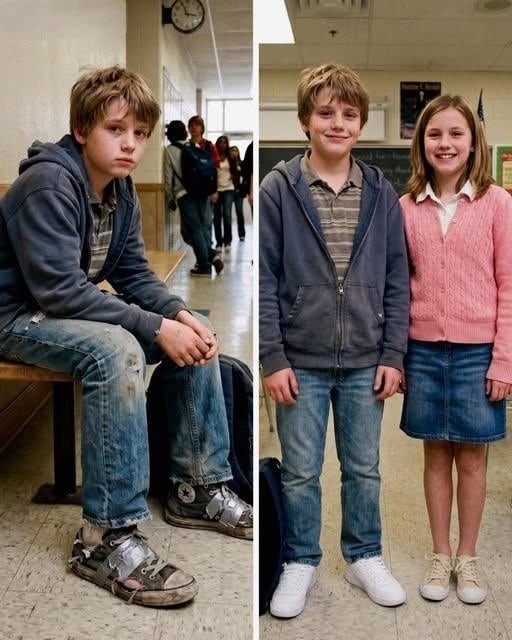
Her hands were still trembling when she stepped into the principal’s office.
The secretary wouldn’t explain much over the phone, only repeating that she needed to come immediately. By the time Emma’s mother arrived at the school, panic had already built itself into worst-case scenarios inside her mind. Fighting. Suspension. Police. Every terrifying possibility crowded together as she hurried down the hallway.
Then she saw the principal’s face.
Pale. Emotional. Almost stunned.
And beside him sat a man she didn’t recognize at first.
He stood slowly when she entered.
The room tilted.
For one disorienting second, her brain refused to connect the image in front of her with memory. Then recognition crashed into her so suddenly her knees nearly buckled beneath her.
It was Caleb’s father.
The man everyone believed had disappeared.
Months earlier, Caleb’s life had quietly unraveled in ways most children at school never fully understood. After his father lost his job, everything else collapsed behind it with terrifying speed. Bills piled up. Their apartment vanished. Stability disappeared almost overnight. Eventually, Caleb had been sent away to live with distant relatives while his father tried desperately to rebuild enough of a life to bring him home again.
At school, Caleb stopped talking much after that.
Children notice poverty instantly, even when adults pretend they do not. Torn shoes. Old clothes. Avoided field trips. Quiet humiliation hidden inside ordinary school days. Emma noticed all of it long before most teachers did.
And unlike many people, she refused to look away.
Without telling anyone, she used money she had been saving for herself to buy Caleb a pair of sneakers after overhearing classmates mocking the holes in his old ones. She left them anonymously at first because she never wanted praise or attention. She simply couldn’t stand watching someone her age carry that kind of shame alone.
She thought the story ended there.
It didn’t.
Now Caleb’s father stood in front of her mother with tears already filling his eyes.
He explained that after months of struggling to survive, he had finally tracked down what happened. Caleb eventually admitted where the shoes came from and who had quietly given them to him. The moment his father heard the story, he said he needed to come personally because gratitude felt too large for a phone call.
Then his voice cracked completely.
He explained that Caleb refused to take the sneakers off for days.
He slept in them.
Not because they were expensive.
Not because they were fashionable.
But because they made him feel normal again.
That word broke something open inside the room.
Normal.
Children do not dream of luxury the way adults often assume. Most simply want the pain of standing out to stop. They want dignity. Belonging. The chance to walk through hallways without feeling exposed every second.
Emma had given Caleb that without even realizing the size of what she offered.
Her mother stood there speechless as Caleb’s father reached carefully into his coat pocket and pulled out an envelope. Inside was a handwritten note alongside a small savings bond made out in Emma’s name.
Not charity.
A promise.
He explained that one day, when Emma was older, he hoped the money would help her continue doing exactly what she had already done naturally: notice people others overlook.
Then he said something none of them forgot afterward.
“When you lose everything,” he whispered, “you start believing people stop seeing you as human. But your daughter gave my son back his dignity before I could.”
Silence swallowed the room after that.
The principal wiped his eyes openly. Emma stared down at the floor, overwhelmed by attention she never wanted. Her mother looked between them all realizing, perhaps for the first time, how quietly children can carry extraordinary compassion without adults noticing.
Because Emma never told anyone what she’d done.
She didn’t post about it.
Didn’t ask for recognition.
Didn’t expect gratitude.
She simply saw another child hurting and responded instinctively.
And maybe that is why the moment felt so overwhelming to everyone standing there.
In a world where kindness is often performed loudly for approval, Emma’s compassion had existed privately, expecting nothing in return. That kind of goodness feels almost shocking because it is so rare and uncalculated.
By the time the meeting ended, nobody in that cramped office looked quite the same emotionally.
Not Caleb’s father, who finally saw proof that his son had not been invisible during the hardest season of their lives.
Not Emma’s mother, who suddenly understood her daughter carried a depth of empathy far beyond her years.
Not even Emma herself, who began realizing that small acts can travel much farther through people’s lives than we ever witness directly.
And perhaps that became the real miracle hidden inside that office:
A pair of shoes could never fix poverty.
Could never erase homelessness.
Could never undo fear or instability.
But compassion had accomplished something money alone often cannot.
It reminded four hurting people that dignity can still survive inside hardship when even one person chooses to see another human being fully instead of looking away.